Showing posts with label family. Show all posts

Sunday, October 7, 2012

History and a Home for a Photo from my Collection

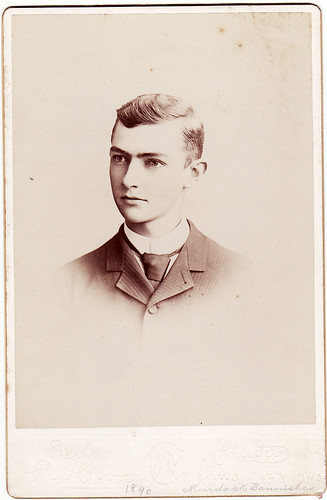
This portrait of a young man was one of the first things I posted on this blog in 2009. I've had it since I lived in California. When I was scanning it I realized that the name on the back was rather unique and so I googled it with the town and soon found out about this young doctor's family and life. You can read the original post here.

When I made the post I had uploaded the photo to Flickr. About a year and a half later I got a comment from someone who was related to him. This doctor, Murdoch Bannister, was his great grand-father.

Can you imagine finding photos of your relatives on the web? I keep expecting it to happen to me sometime.

Anyway, I responded to him in a Flickr comment and asked if he would like the photo. As I wrote about in the post a couple years ago when I sent a whole box of postcards back to the family - as much as I love these treasures I would most likely always give them up to have them be with the family again.

It took a long time between messages, but Murdoch Bannister's great grandson, Joe, and I finally connected and this portrait is going back to him and his family in Texas.

As a trade I asked Joe if I could post some of his history about Murdoch Bannister and his legacy. He sent a wonderful account. I hope you enjoy it. And I am glad to send the photo home with his family.

Dr. Bannister had a medical practice in Ottumwa, Iowa for many years; his father (Dwight) was an army colonel who served during the Civil War, and his son (also Dwight, named after his grandfather) was a newspaper publisher and the professor of large animal surgery in the veterinary department at Iowa State in Ames. Dr. Bannister's wife Keota was the daughter of Judge Morris Williams, and was one of the first woman licensed to practice law in Iowa. 
It's not surprising that a picture of Murdoch Bannister ended up in California. Dr. Bannister's mom (Lavinia) was the niece of the prominent abolitionist attorney and newspaper publisher Francis Murdoch, who moved to Santa Clara County, California in 1847. 
The Murdochs and the Bannisters remained close through at least the late 1960s, with cross-country trips and letters, so there was a fairly robust Iowa-California exchange between the descendants of Colonel Bannister's kids and in-laws. 
My mother and aunts remember waiting in my great-grandfather's office for their dad to close up the newspaper and take them home after school. My aunts would pass the time by grossing each other out with pictures from Grandfather Bannister's medical references.
One of our bits of family history is an entertaining letter that Dr. Bannister sent to his family toward the end of his residency (around 1895). 
My great-grandfather's residency had included care of patients in a hospital burn ward in Philadelphia, and the emotional toll of treating severely burned patients was evident in his description of the experience (third-degree burns were effectively a slowly enforced and torturous death sentence prior to the discovery of antibiotics and the development of skin transplants).
Dr. Bannister wrote very movingly of one of his patients, a vivacious teenage girl who had been burned over 70 percent of her body when her voluminous skirt was set ablaze by a stray kitchen spark (this would have been about five years after the date that Murdoch's picture was taken). She fought to live for a full year in almost inconceivable pain before succumbing to sepsis. 
His experiences weren't all grim. He spent a lot of time socializing with his fellow doctors and medical students, and he had a sometimes witty sarcasm. 
He served as an Army doctor in WWI, and he was appalled by the inhuman conditions of trench warfare. He subtly subverted the military bureaucracy by sending soldiers home at their request, by signing medical discharges from service with diagnoses of horrible-sounding diseases with long Latin names.
If anyone had bothered translating the diseases, they would have found that he was recommending honorable discharges for things like untreatable combat-related "severe chronic hangover. 
If you've regularly hunted through stacks of antique pictures at vintage stores and estate sales, I'm sure you've looked at stacks and mounds of photographs of these long-dead and long-forgotten strangers.
So many are nameless and lost, staring out at us in the fullness of youth and hopefulness, that they cannot help but remind us of our own transience and fragility, and of yawning oblivion. I'm glad you found my great-grandfather, and I'm glad that I can tell you he had a good life and was well-loved, and that he is still remembered fondly.

Friday, September 3, 2010

home again


I am sending off all of the postcards with the holes in them that I wrote about first here and then here.

I wrote the daughter of George Kimber after the last post, finding her university email address. I told her about them and offered to send them back to her family if they wanted them.

Here is part of her response:

Your e-mail comes at a propitious time. When I got to England I discovered that my sister and her husband are actually assembling family material to write up the history of Arthur C. Kimber (my grandfather) and his son Arthur C. Kimber (my uncle who died in action during the last year of the first world war). These postcards would be a great help in producing a time-line of the family’s activities in these years. (We have no idea – yet - why the postcards have holes in them!)


Can you imagine someone emailing you out of the blue and knowing all this stuff about your family, writing about it on the web and having a box full of related postcards to all members of your family! I can't. And yet, I was presenting that to her. How could I not when I saw I could contact her?

As much as I love my vintage photo and postcard collection, I also would gladly give them all away to the rightful owners. I think most collectors would. We appreciate them so much, but also acknowledge that in the wonderfulness of these paper records is sadness that this little history is no longer with the family.

Postcards especially contain in them little everyday moments. Especially in the early part of the twentieth century when they were sent all the time and not just on vacation.

Now, the remainder of the Kimber family can see some of these moments that they have never seen before. This makes me happy and I wish I could see their reaction to opening the box and looking through the postcards the first time.

Wherever they were the last few decades, they will be back with the family soon. Off they go!

Monday, July 5, 2010

history and happenstance in a shoe box

Image heavy and really neat post below. Click on the postcards to see them bigger.


Earlier this week, while I was preparing the previously mentioned distressed postcards for sale, I noticed for the first time that most of them are addressed to the same last name.

I googled the first one, a Dr Arthur Clifford Kimber and found an extensive history about his son George Card Kimber and his family. George Kimber was a Geographer and the first Vice President of the Association of Pacific Coast Geographers. In later years was a farmer in the California Bay Area. He died in 1960.

His father was a Doctor and Reverend who died in 1909. After that the family moved from New York to California.

The history online was very thorough and was provided by his daughter, Clarrisa, a Professor Emeritus of Plant Geography at Texas A&M.

What is amazing is that my box of messed up postcards are all in-my-hand evidence of the timeline from this online history recalling 100 years ago. I have postcards addressed to the Rev. Dr. Kimber, to his wife, to George and to his brother John and Clifford (who died heroically in WWI). I have postcards from the sons to their parents. I have postcards that show addresses from Canterbury, England to Mountain View, Ca. The postcards I have all seem to be from 1905-1912.

How remarkable. Even more remarkable is the fact that I can look up via Google street maps and can see where they lived!

From the history of George Kimber found here.

George Kimber was born July 4, 1898 in Brooklyn, New York. His father was Dr. Arthur Clifford Kimber, Jr, Vicar of St. Agustine Mission Chapel in Trinity Parish, New York City. Both his father's parents had come to America from England in the early 19th Century.

George's mother was Clarissa Evans, music teacher and daughter of two old up state New York farming families. George was the youngest of three boys...Throughout his life he was influenced by religion, the temperance movement and music.

This postcard is from Jan 1908, a notice of a change of address from a music store to Mrs Kimber
(now it is a Stur Dee Products store).


As a very young boy, he had a year (1903-4) in England at the Froeble Academy in Canterbury, Kent during the time...his mother took lessons in music and pedagogy. Upon the family's return to New York, his mother took him to be interviewed by the Prescentor at the Episcopal Cathedral of St John the Divine. He was found to have a nice voice, untrained, but he could hit high C!

The postcard below was sent in April 1908.


A postcard dated August 16, 1908 to George Kimber sent to this address in Canterbury, England. It looks as if the whole family went back to England around this time for a visit.


The family moved from Brooklyn to Manhattan in 1908 to be closer to the Cathedral school and their father's church.


A postcard dated Feb 11 1907 sent to George Kimber. He would be 13. Here is where they lived in Brooklyn:


A postcard not dated. Sent to Mrs Arthur C Kimber, Georges mother. Her name was Clarissa. Here is where they lived in Manhatten:


When George's father died in 1909, his mother decided to take her sons to California where her family was then living.

This is the obituary of the father, found online, from The New York times archives. Dated July 27 1909.


They sailed via Cuba for New Orleans where they would take the train on to California. Upon reaching Los Angeles, they proceeded to his aunt's ranch in Hanford, Kings County which was the Evans' family headquarters at that time.

Here is a postcard sent to the George's brother, Clifford on May 16th 1910. (The front of this card is the children with the flag in the previous post.) Here is where they stayed in Hanford. That was ranch land back then.


Mrs. Kimber was anxious to raise her sons in an academic setting and went to Berkeley, the location of the University of California. She became a music teacher using her skill and developing interest in pedagogy.

Here is a postcard from only a month later, dated June 25 1910, sent to George. It is the 4th of July card shown at the top of my previous post. (The 4th of July was George's birthday. Odd how I did that post yesterday on the 4th without knowing that.) It was forwarded to this address in Berkeley.

After a year in Berkeley, she found the city too large and an uncongenial social environment. She decided to move to Palo Alto across the bay where the Stanford University faculty might have a stronger influence on the social climate of the much smaller town. Able to sell some property in New York City from her husband's estate, she bought a small farm nearby.

It looks like the farm was in Mountain View. I lived in Mountain View and there are no farms there anymore, as you can imagine. I wish I could find a postcard with an address from Mountain View, but it was so rural they weren't needed. Here is a postcard to Mrs Kimber from Jan 17, 1912.


You can read all about George and his family, which is impressive and very interesting here. This is where I got the info from. They sure did a lot of moving around for a while.

I had no idea when I first got this box of damaged postcards what it contained. The formative years of a families life from 1905-1912. They moved many times during those years and lost a father. Most of the messages are very short and general. Some are more detailed. Many of the postcards I have are blank. There are some from the Stanford Campus and SF area that were postcards of the 1906 earthquake. This makes me think that at least a number of these if not all of the blank postcards are theirs.

But the real question here is why do they all have at least one hole in them? What happened to them? Maybe the boys used them for target practice out on the farm in Mountain View. They were pretty dusty when I got them. I wiped each one of them off. Probably cleaned off dirt from 100 years ago.

Maybe they were nailed on a wall and quickly yanked out? The small rusty nails that are in a couple of them would support this. Maybe the boys lined a fort wall with them.

Perhaps the farm or fort was on the same land that I ended up living on 90 years later.

All these little pieces of paper I collect, every little one of them, hold stories, represent lives and precious memories to people who are most often no longer here. It is remarkable, exciting and sometimes overwhelming.

If you got this far, thanks for reading and following me on this discovery.

Saturday, December 12, 2009

a family christmas card

christmasfamilycard

I wish there were signatures on this card. I have decided that this family is from Southern California, due to their sleeveless outfits. I am also going to guess that this is from around 1970.

My family never did the photo Christmas cards. It is kind of curious that we didn't considering my father was a photographer. It was probably too much money.

Friday, August 7, 2009

nothing like family

This is one of my favorite photos. It came from a scrapbook that I bought full of mostly black and white photos from this family. I believe that woman in the bikini there is the little girl in the Fifties photos in the book, all dressed up for the Rose Festival and singing in pageants.

What I love about this photo is that it shows all the in-jokes and fun you have within a family. I assume these people were a lot like my family. We can laugh about ourselves just as easily as we can laugh at you.


Sunday, June 21, 2009